Saturday, March 24, 2007

Can Mozart help a pregnant woman?


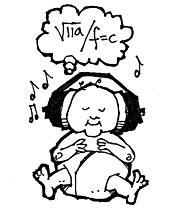
I work a lot with pregnant women and they all want to know about the very best music to listen to during their pregnancy. Of course I always tell them that their voice singing to their unborn child is the best. The mother's voice is the one that baby hears first and most often while in utero and therefore that one that makes baby feel safe.


But what about Mozart? Well, many Marketers jumped in on the whole "Mozart Effect" media blitz and said that Mozart would make your baby smarter, happier, sleep better and all kinds of wonderful things. To my knowledge, no research has ever proven or even suggested that, so decide for yourself. Mozart certainly is not going to be bad for your baby but mother's voice softly crooning to baby is undoubtedly the best!

Monday, March 05, 2007

Mozart: Good for Weddings?


As you probably know by now, I was at a family wedding in Las Vegas this past week-end and was looking for evidence of healing music everywhere I went. Not surprisingly, the only really beautiful healing music I heard was at the actual wedding. The pre-wedding music as well as the wedding music was a medley of famous classical music pieces, including Mozart. Even though the wedding was outside and the weather was a little bit "shivery," the music was beautiful and relaxing. It did truly set the tone for a spiritual and long-lasting commitment. Mozart is always a good choice for weddings. Let me know if I can help you!

Wednesday, February 14, 2007

Did Mozart Have a Valentine?

http://www.healingmusicenterprises.com/listmailings/love/Valentine's%20Day%2020
Did Mozart celebrate Valentine's Day? Probably not. Mozart was a loving and romantic guy and it only takes a glance at his operas to know that love was on his mind. If you've seen the film "Amadeus" then you know that romance, intrigue, and beautiful music were an integral part of his mind and his life. I would recommend seeing "The Marriage of Figaro" or "Cosi Fan Tutte" if you want to experience a wonderful Valentine's Day treat! Let me know what you think!
P.S. You can cut and paste the link above to get a Valentine's Day ebook as my gift to you

Saturday, January 27, 2007

Happy Birthday Dear Mozart


We've been talking about him, listening to his music and studying his music and it's effect on pople for at least a decade, but for the last year we've been celebrating his 250th birthday. After a glorious year of concerts and tributes of all kinds, it has come to an end today with the celebration of his 251st birthday!


Take a few minutes today or tomorrow and listen to some of this beautiful, melodic and sublime music

Wednesday, January 24, 2007

Mozart's Birthday is almost here!!


Well, we been talking about it for a full year now. Talking about what?? Mozart's birthday!! The whole year of 2006 we were celebrating Mozart's 250th birthday. On the 27th of January, two days from now, we'll celebrate his 251st birthday! There will probably not be quite as much celebration about one of his birthday again until 2051, when he will be 300 years old! Wow! And I'll be 103!! Even more amazing to me! But enough of this silliness. Mozart was truly one of the greatest musical geniuses that ever lived and his music makes my life so much richer and more enjoyable. Do you know the piano concertos, the violin concertos or any of his operas? If not, start there; they are so gorgeous and so exciting that you'll forget any troubles you might have. Go ahead and get yourself a new CD or some concert tickets and bathe yourself in some of the most sublime music ever!!

Monday, December 25, 2006

Final days of Mozart's 250th Birthday


Well, did you enjoy the year of Mozart's 250th birthday?? Some of the most fantastic concerts of the 21st century to date have been played and I was fortunate to hear several of them. Mozart was one of the greatest musical geniuses of all times. If you haven't had a chance to listen to a piece of Mozart's music or read one the many outstanding biographies of this man, take a couple of hours and do so before the end of this awesome year!

http://www.healingmusicenterprises.com/NeedSomeLast-minuteGifts.htm

Sunday, December 10, 2006

What about Mozart's contemporaries?


You know Mozart's music has been put forth as the ideal healing music for helping with a variety of medical conditions. I met a psychiatrist a few days ago who was recalling a scene from "Amadeus" in which Mozart's usic was being described by his contemporary and rival Anton Salieri. Even Mozart's contemporaries recognized his amazing genius and unparalleled beauty of his music. But what about the ability of his contemporaries' music to heal? I think that many works by Haydn, Albrechtsberger, even Salieri can be calming, serene and have the organization that is so important to preparing the mind for standardized tests. Luckily, Mozart wrote 622 individual works of music so there's no shortage of this beautiful music, but if you would like to hear some of his contemporaries, I think you'd find their music very pleasing! You might also want to check out www.mozartforum.com.

Monday, November 27, 2006

Dr. Alfred Tomatis and Mozart

In April of 1991, I was very fortunate to study with Dr. Alfred Tomatis at the Tomatis Center in Phoenix, AZ. I attended a two-week seminar entitled "The Healing Power of Gregorian Chant." I had no idea how wonderful and enlightening this would be! It was Dr. Tomatis who told all of us (including Don Campbell) about the power of Mozart to help autistic children, people with a wide variety of emotional problems and learning disabilities to heal with Mozart violin concertos and Gregorian chant.

One of the things that Dr. Tomatis did so much research on was music and the unborn child. He was a great proponent of lullabies, especially for fussy, cranky babies. The album that I recommend is "Lullabies for Mother Baby Bonding" and includes a lullaby that Mozart himself loved!

Dr. Tomatis work is featured on many websites which I would urge you to check out. Just Google "Alfred Tomatis." His work is still not that well-known but I predict it will be one day.

Saturday, November 18, 2006

Does Mozart's music make you smarter?


Saturday, November 18, 2006

Many of you have probably heard of "The Mozart Effect." The original research, done in California at UC Irvine, showed that Mozart's Sonata in D Major for Two Pianos helped highschool students score higher on the Scholastic Aptitude Test than students who listend to other music before the exam or those listened to nothing. This was exciting news and was widely reported in the media. Later, some marketers began suggesting that Mozart's music actually raised your IQ and "made you smarter." Not true. Neuromusicologists suggest that Mozart's music may help you to organize your thoughts and may be good to listen before or during a task. It's also beautiful, brilliant music. But it won't make you smarter! Sorry.

Tuesday, October 24, 2006

Was Mozart an active Healer?


Many people have asked me this over the past 10 years. It's a fair question, I think. For someone whose music is said to be so healing, you might think that Mozart actually was a healer but there is no evidence whatsoever that he ever thought of himself in those terms.

As a matter of fact, Mozart's life was extremely chaotic and he was always running around at the last minute finishing up the symphonies, concertos, and chamber music that had been commissioned for him. You may or may not realize that Mozart died a pauper...destitute...and was buried in an unmarked grave in Vienna. Such a brilliant man who wrote music that was all of genius quality. So tragic.

Monday, October 09, 2006

Research says Mozart Effect is dubious?


Scientists have discredited claims that listening to classical music enhances intelligence, yet this so-called "Mozart Effect" has actually exploded in popularity over the years.
Why, no one is really sure. It appears that the more people literally disprove this urban myth, the more people want to believe it. Is the Mozart Effect like Santa Claus, the Tooth Fairy, or the Easter Bunny? We hope not but the original effects have never really been duplicated.

Tuesday, September 26, 2006

More about Mozart


Scientists argued over whether the phenomenon had a relatively simple explanation, such as just improving a person's mood, or if the effect was tied to a unique quality of the Mozart's compositions. One study reported that the particular rhythmic qualities of Mozart's music mimic some rhythmic cycles occurring in human brains.
Now Rauscher and her collaborator Hong Hua Li, a geneticist at Stanford University in California, think they have found the molecular basis of the Mozart effect. Their study used rats, which, like humans, perform better on learning and memory tests after listening to the sonata.
The researchers found that these smarter rats had increased gene expression of BDNF, a neural growth factor, CREB, a learning and memory compound, and synapsin I, a synaptic growth protein, in their hippocampus, as compared to control rats who had listened to equivalent amounts of white noise.

Molecular Basis for Mozart Effect Revealed!

This article appeared in 2004: 15:10 23 April 2004
NewScientist.com news service
Emily Singer, San Francisco

New research has revealed a molecular basis for the "Mozart effect" - the observation that a brief stint of Mozart, but not other music, may improve learning and memory.
Rats that heard a Mozart sonata expressed higher levels of several genes involved in stimulating and changing the connections between brain cells, the study showed. The team, including the researcher who first proposed the Mozart effect, hope the results will help them design music therapy treatments for people suffering from neurodegenerative diseases such as Alzheimer's.
The Mozart effect first came to light in a 1993 paper in Nature (vol 365, p 611), when Fran Rauscher, a neuroscientist at the University of Wisconsin Oshkosh, US, and colleagues showed that college students who listened to Mozart's Sonata for Two Pianos in D Major for 10 minutes performed better on a spatial reasoning test than students who listened to new age music or nothing at all.
The findings sparked excitement from the general public - specially designed Mozart CDs leapt up the music charts - and some scepticism from the scientific community.

Friday, September 22, 2006

Have you tried playing Mozart yet?

After my last post, many people emailed me to say that they really wanted to try using Mozart for increased concentration when doing tasks like homework, balancing a checkbook, working on taxes, etc. Many people asked which Mozart pieces were best. According to Dr. Alfred Tomatis, who first observed this cause and effect phenomenon back in the 1950's, the five violin concertos of Mozart are the very best pieces to listen to if you want to experience increased concentration.

For true healing effects you would want to listen to the Mozart that relaxes and calms you best. I would suggest the slow movements of not only the violin concertos but also slow movements of piano sonatas, string quartets and symphonies. There is a beautiful solo piano piece called "Adagio in b minor" that is absolutely exquisite. I would recommend getting a recording of that just for pure relaxation! I may make a recording of it myself!

Friday, September 15, 2006

What is it about Mozart's Music?


People are always asking me what it is about Mozart's music that is healing or helpful. Why isn't Haydn's music as powerful, or Beethoven's or Schubert's? Actually, I believe that any great composer's music can be healing, keeping in mind our definition of healing. Remember that we define healing as "amelioration of symptoms." Healing is not synonomous with curing!

Starting back in the 1950's, a brilliant French ear, nose, and throat doctor and surgeon with a great love of music, starting treating many opera singers with various physical symptoms that prevented them from singing like they had. This man was Dr. Alfred Tomatis. One of his statements that was someone novel at the time was "the human voice cannot reproduce sounds that it cannot hear." Dr. Tomatis looked at hearing deficiencies that the patients exhibited and discovered that when the patients listened to Mozart's five violin concertos, in particular, that their hearing improved. Dr. Tomatis determined that these particular pieces of Mozart had the perfect range of pitches and the perfect timbre or tone color to heal the voice and the individual.

In the 1990's research was being conducted at the University of California at Irvine in which Mozart's Sonata in D Major for two pianos was being played for high school students about to take the SAT. In each trial, the students were divided into three groups. One group listened to their favorite pop music for 30 minutes before the test, one listened to nothing and one group listened to the Mozart piece. Repeatedly, the students who listened to the Mozart piece scored higher.

These two phenomena constributed to the idea of a "Mozart Effect." I personally believe that the media has greatly exaggerated the power of Mozart however I do believe that Mozart's music is healing, inspiring, beautiful, uplifting and amazing. Many people believe that Mozart was the greatest composer of all time because in his brief life, he was a master of every genre he attempted and he attempted all of the genres of his time: sonatas, symphonies, chamber music, opera, and choral music. If you haven't listened to any Mozart lately, treat yourself to some tonight!

Tuesday, September 12, 2006

Why Mozart?


There's been a lot in the popular press over the last 10 years about Mozart and his music as tools for healing, improving test scores, and raising one's IQ. I am very familiar with the reasons and circumstances that led to all of the hype, but is it really hype or is there substance to it?

I would like for this blog to be an investigation into the healing properties of Mozart's music in particular but all the other positive properties of Mozart's music.

Please post your own comments often!